What Comes Next for the Cleared Block Across From the Roundhouse
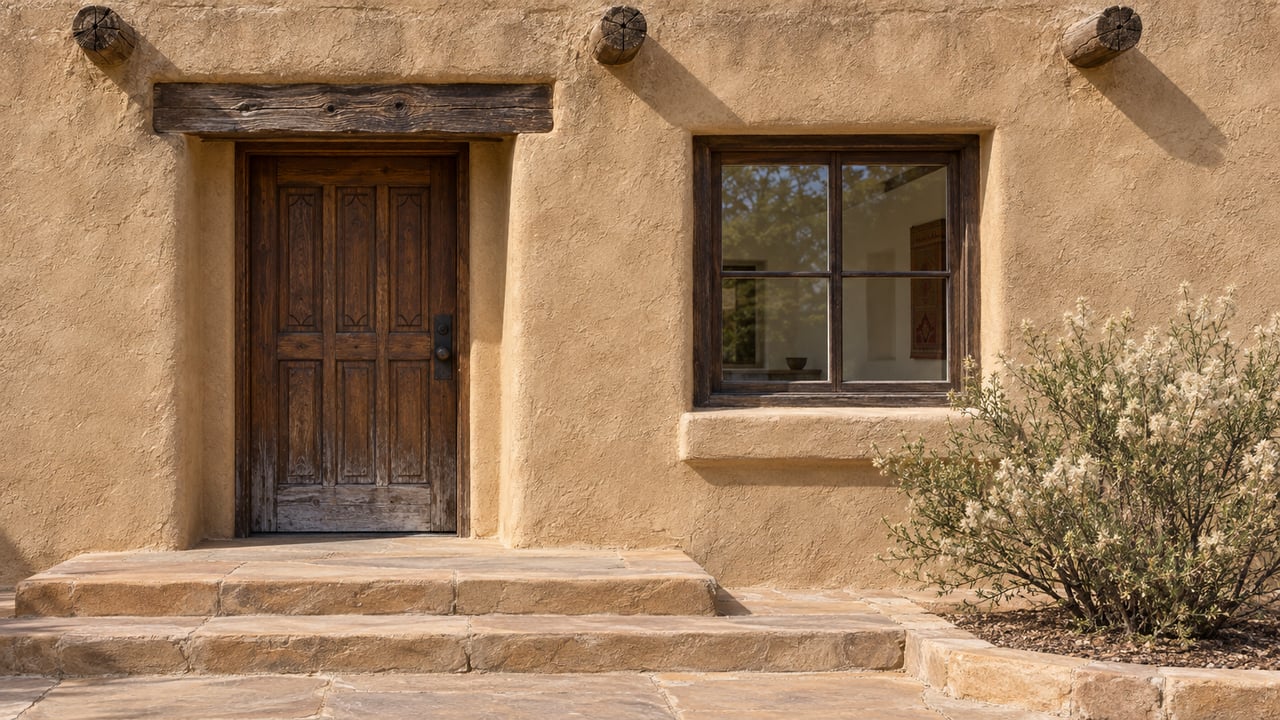
In April 2026, the State of New Mexico demolished four small Pueblo-Spanish Revival casitas in the 400 block of Don Gaspar Avenue, across the street from the Roundhouse. They are meant to be replaced by an executive office building of about 165,000 square feet. The state's most recent public status report says that building is still in schematic design, and construction bids are now set for early 2027. That puts it a step behind the schedule state officials gave when demolition began.
For anyone who lives in South Capitol, the lot sits on the walk between Don Gaspar and the Plaza. It looks like a fresh start. In fact it is the last piece of a residential pattern that the Capitol campus has been taking in for more than sixty years, and the next chapter is still on paper.
The state's own project memo dates the casitas at 402 to 414 Don Gaspar to around 1930. City historic preservation materials describe the surrounding Don Gaspar area as an early-20th-century residential subdivision, built mostly between the 1890s and the 1940s, where Anglo-American house forms picked up traditional Santa Fe design elements. Those same materials say the casitas' dates and footprints place them within that Don Gaspar residential pattern.
By the time the excavators arrived, the houses had been state property for years and served as offices. The Santa Fe Reporter called them "the last of the tiny homes that once made up a section of the vanished Don Gaspar neighborhood." Edward Archuleta, chairman of the Old Santa Fe Association, told the Santa Fe Reporter that the casitas "were not historically nor architecturally significant" but "were still excellent examples of Pueblo-Spanish revival design and contributed to the fabric of the historic district."
The casitas are easier to understand as the end of a long sequence than as a single loss. Pulling together the state's review file, the Secretary of State's Capitol history and local reporting gives this timeline:
One detail from that list returns in the next phase. The Concha Ortiz y Pino Building, which started the absorption of the neighborhood, was itself among the buildings approved for demolition to make room for the new complex.
As the project's footprint grew, the casitas stayed in the way. By December 2025 the 56,000-square-foot concept had grown into a 163,000-square-foot complex for five state agencies, linked to the Roundhouse by a walking bridge. The December board vote reversed a decision the board had made the year before. After the vote, board member Jennifer Biedscheid explained her reasoning, as reported by the Santa Fe New Mexican:
"While Santa Fe is known for its historic identity, it also identifies as the state capital. State government exists here. We can't contradict that fact, and its ability to function needs to be a serious concern."
According to the Santa Fe Reporter, the Old Santa Fe Association considered appealing the decision to the city council. Archuleta told the paper, "we realized we had no chance of winning." Grancor Environmental of Albuquerque won the demolition and remediation contract.
The state made its own case to the review board in practical terms. The Office of the State Auditor said its leased space on Santa Fe's south side was too small and lacked adequate security, and that it needed to be closer to the Capitol. The deputy secretary of state said that agency had run out of room in its North Capitol building.
As of April 2026, General Services Department spokesperson Joe Vigil described a building of about 165,000 square feet with an occupancy of around 565 and 585 parking spaces on three tiers. The parking plan has already shrunk once. A June 2024 concept memo called for more than 700 below-grade spaces, with vehicle access proposed at the southwest corner near the Galisteo public garage. That access point was part of a concept, and no later source confirms it.
Reports differ on which offices will move in. The Santa Fe New Mexican reported GSD's April list: the Department of Finance and Administration, the Secretary of State's Office, the State Treasurer's Office, the Office of the State Auditor, the Higher Education Department and the Lieutenant Governor's Office. The Santa Fe Reporter gave a shorter list in the same month. Neither list has been confirmed in a later state document. The walking bridge to the Roundhouse from the December 2025 description also has not been confirmed in the current design.
The price has been reported in two very different ways, but the numbers fit together. The $95 million the Legislature approved in 2026 is one funding installment. It is not the full cost. The state's 2026 to 2030 capital improvement plan lists a total project cost of $185 million, with $85 million funded to date. That earlier $85 million appears in the Legislative Finance Committee's quarterly report as two appropriations for the building, one of $15 million and one of $70 million. The plan's $185 million total falls within the $184 to $200 million range the Santa Fe Reporter cited in December 2025.
When demolition started, the timeline sounded close. GSD said design should be done by October 2026, construction bids would be requested at the end of the year, and the building was "scheduled to be built next year." The Legislative Finance Committee's August 2026 capital outlay report, which reflects project status as of June 2026, shows something slower.
| Milestone | April 2026, per GSD | As of June 2026, per LFC |
|---|---|---|
| Design | Complete by October 2026 | In schematic design |
| Construction bids | Requested at end of 2026 | Put out to bid in early 2027 |
| Casitas | Demolition underway | Demolished |
Schematic design is the earliest of the formal design phases. Construction documents still have to be drawn, bid and awarded after it. No general contractor has been publicly named. No construction start date has been announced. No plan for street closures or traffic control on Don Gaspar, Capitol Street or Galisteo Street has been published.
That fills in what the next stretch on this block looks like. The Don Gaspar residential pattern began around the 1890s. Its last four houses are gone, and their replacement is a set of schematic drawings with a bid date in the next calendar year. For now, the block is a cleared lot.
Each upcoming milestone will show up in a public record before it shows up on the street:
Until those appear, the cleared ground in the 400 block of Don Gaspar is the most visible marker of a project that is still being drawn.
If you've been watching this block and wondering how a large state project across from the Roundhouse fits into your own plans for a South Capitol home, I'm glad to talk it through. With decades in Santa Fe real estate and title work, Robyn Tyra pays close attention to changes like this one and can walk you through what the public record shows as it develops. Let's Connect.
Robyn Tyra is a seasoned real estate professional with more than 35 years of experience in both real estate sales and title insurance across Northern New Mexico. Deeply connected to the region’s rich history, diverse culture, and breathtaking landscapes, she takes pride in helping clients find their place to call home in Santa Fe and beyond. Known for her dedication to building lasting relationships, Robyn guides clients through every step of the buying or selling process with clear communication, integrity, and a seamless approach. Her greatest reward is seeing clients achieve their real estate goals while embracing the unique lifestyle that Northern New Mexico offers.
📍 123 E Marcy St., #101, Santa Fe, NM 87501
📞 (505) 982-0330


I have spent my career in Northern New Mexico in the real estate industry with over thirty five years in both real estate sales and title insurance. My commitment to you is to make the real estate process of buying and selling as seamless as possible through active communication and listening. We will work together every step of the way to reach your real estate goals.